
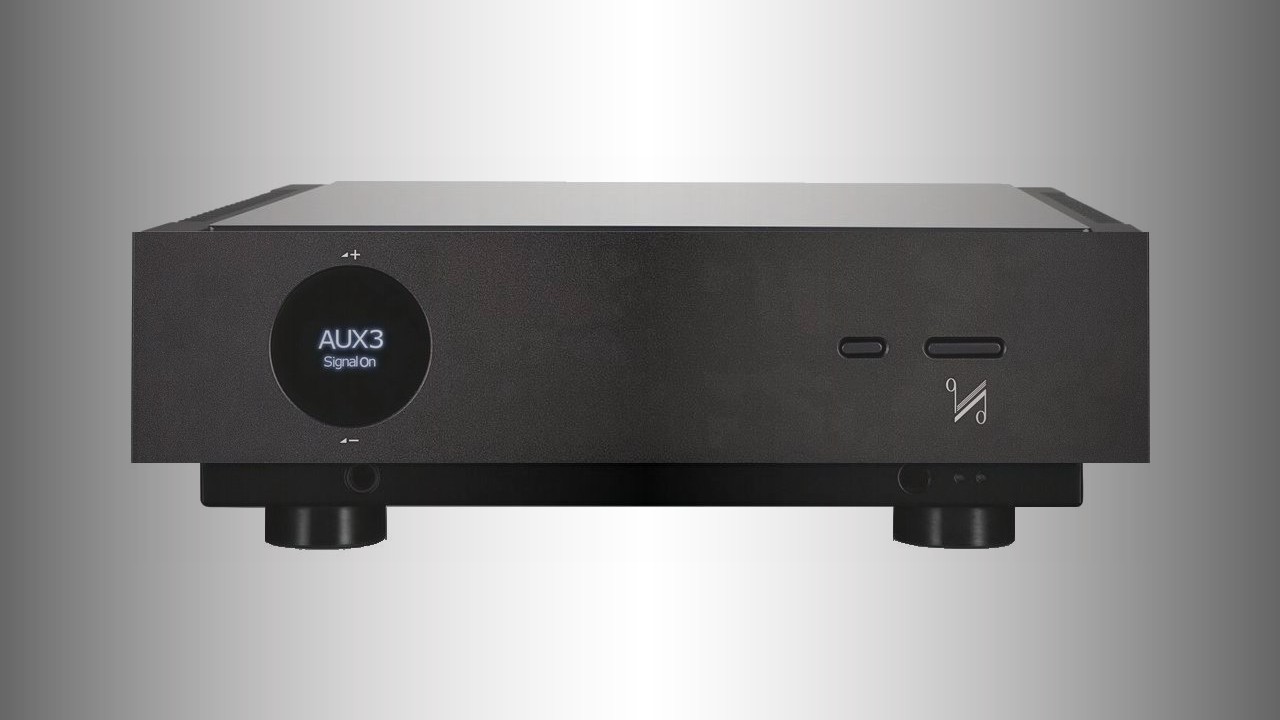
The Quad Artera Pre is a preamplifier for listeners who want more than simple source selection and volume adjustment. Led by Jan Ertner, with collaboration involving Audiolab, its design places unusual emphasis on power supply regulation, analogue signal handling, input-by-input adjustment and practical system control. Rather than presenting tone control as an afterthought, the Artera Pre integrates Quad’s distinctive Tilt approach, allowing the overall tonal balance to be shifted in a controlled and repeatable way. Combined with MM/MC phono support, balanced XLR connectivity, trigger outputs and a built-in headphone amplifier, it is positioned as a serious analogue hub for a modern hi-fi system.
A preamplifier built around control, not complication
At the heart of the Quad Artera Pre is the idea that a preamplifier should help a system work as a coherent whole. It provides multiple analogue inputs, adjustable output options, per-input sensitivity settings and tone-shaping tools that can be assigned individually. Those details matter because real systems often combine sources with different output levels, different tonal characters and different connection standards.
The Artera Pre includes four stereo RCA inputs in total: three line-level RCA inputs and a built-in phono input. It also provides a balanced XLR input for users whose source component offers balanced output. On the output side, it offers adjustable balanced XLR and unbalanced RCA outputs, plus a fixed-level RCA output. This gives the preamplifier useful flexibility whether it is connected to a power amplifier, an active sub-system, recording device, headphone listening arrangement or another line-level component requiring a fixed feed.
Its dimensions of 320 x 105 x 320 mm and weight of 7.8 kg suggest a compact but substantial component, in keeping with the Artera series’ emphasis on focused system building rather than oversized casework. Black and silver front panel finishes are available, allowing it to fit visually into different equipment racks and room settings. The supplied remote control also reinforces its role as a day-to-day control centre rather than a component that expects constant front-panel interaction.
Why the Tilt tone control is distinctive
One of the defining features of the Quad Artera Pre is its Tilt tone control. Unlike conventional bass and treble controls that adjust the frequency extremes separately, Tilt changes the relationship between the upper and lower frequency ranges at the same time. As one part of the spectrum is strengthened, the other is attenuated, or the reverse. The adjustment is made in 1 dB steps around a stationary point located at approximately 700 Hz, so the response effectively leans in one direction or the other.
This approach can be attractive because it is broad and systematic rather than narrowly corrective. A listener may prefer a slightly warmer or slightly more forward presentation depending on the source, recording, room furnishing or loudspeaker balance. The Tilt function offers a structured way to make that kind of adjustment without needing to treat bass and treble as completely separate problems.
The Artera Pre also includes a stepped low-frequency adjustment with three settings: -4.5 dB, 0 and +4.5 dB. This can be combined with Tilt settings and, importantly, these adjustments can be applied individually for each input. That means a turntable, DAC, tuner or other source can each be given its own compensation profile if required. For an owner with several sources of differing character, that per-input memory can make the preamplifier more useful in everyday operation.

Input matching and direct signal paths
The Artera Pre gives each input individually adjustable sensitivity from -8 dB to +8 dB in 0.5 dB steps. This is a practical feature that is easy to underestimate. In many systems, one source may be much louder than another at the same volume setting. That can make source switching awkward, especially when moving from a low-output source to a high-output one. Input sensitivity adjustment helps align levels so the system behaves more predictably.
All inputs can also operate in direct mode, passing the signal through with minimal interference. This is useful for listeners who want the option of bypassing additional processing or correction on a source-by-source basis. In other words, the Artera Pre does not force its tone facilities into every listening scenario. It allows the owner to decide when adjustment is useful and when a more direct route is preferred.
The four-channel volume control is also described as corresponding to the switching architecture. Alongside the stated channel unbalance figure of ±0.02 dB at 1 kHz and channel separation of more than 100 dB at 1 kHz, this points to careful attention to level handling and channel consistency. For a preamplifier, these are central concerns: its job is to manage delicate analogue signals while preserving balance between channels and providing dependable volume control.
Built-in phono stage for MM and MC cartridges
The Artera Pre includes a Class A built-in phono input that can be switched for moving magnet and moving coil cartridges. This is an important part of its appeal because it allows a vinyl source to be integrated without automatically requiring a separate phono preamplifier. For users building an analogue system around a turntable and power amplifier, that reduces box count and simplifies cabling.
Support for both MM and MC cartridges also broadens cartridge compatibility. Many built-in phono stages are limited to moving magnet designs, but the Artera Pre is specified to handle both types. That gives the owner more freedom when choosing or upgrading a cartridge, while keeping the phono path within the same control unit as the rest of the analogue sources.
Because the phono input sits alongside three additional RCA line inputs and one balanced XLR input, the Artera Pre can accommodate a mixed system without treating vinyl as a secondary function. A turntable, balanced source and several single-ended line sources can all be connected simultaneously, with level and tonal adjustments applied as needed.

Power supply attention and measured operating targets
The Artera Pre’s power supply includes 11 adjustable power rails, some of which are ultra-low noise. In a preamplifier, power supply design is especially significant because the component works with low-level signals and must avoid adding noise or instability before the signal reaches the power amplifier. Multiple regulated rails allow different internal stages to be supplied according to their specific requirements, rather than relying on a single broad supply arrangement.
The published specifications include a frequency response of 20 Hz to 20 kHz at -0.2 dB, harmonic distortion of less than 0.001% from 20 Hz to 20 kHz, and signal-to-noise ratios of 110 dB at 1 kHz and 118 dB A-weighted at 1 kHz. Output voltage is specified at 0–2.5 V via RCA and 0–5 V via XLR. These figures describe a component intended to serve as a low-noise, low-distortion control stage between sources and amplification.
The ability to dim or turn off the display is another small but practical design choice. Many listeners prefer a darkened room or reduced visual distraction during listening. Display brightness control supports that without affecting the core functionality of the unit. Power consumption is specified at 45 W.
Headphone amplifier and system integration
The Quad Artera Pre is not limited to loudspeaker listening. It includes a built-in headphone amplifier with a discrete Class A output stage and low output impedance, accessed through a 6.35 mm headphone output. This gives the preamplifier a secondary role as a headphone listening station, useful for late-night listening or for users who want a high-quality headphone output integrated into the main analogue system.
For system integration, the inclusion of two 12V trigger outputs is particularly useful. These can be used to control the activation of external devices such as power amplifiers. In a system with separate preamp and power amp components, trigger connections reduce the need to switch each component on manually and help the system behave more like a unified installation.
The combination of adjustable pre-outs, fixed-level output, balanced and unbalanced connectivity, remote control and trigger outputs makes the Artera Pre more than a minimalist analogue switchbox. It is designed to coordinate sources, amplification and listening modes while giving the owner meaningful control over level, tonal balance and system behavior.

Who the Quad Artera Pre is most suitable for
The Artera Pre is best suited to listeners building a separates-based analogue system who value flexibility and precise control. It is particularly relevant for owners with multiple sources, including vinyl, who want to match levels, tailor tonal balance per input and connect to either balanced or unbalanced downstream equipment. It also makes sense for systems where a dedicated preamplifier is needed to partner a power amplifier, especially when trigger switching and remote operation are desirable.
It may also appeal to listeners who like the idea of tone adjustment but do not want crude or constantly intrusive controls. Quad’s Tilt system is distinctive because it provides broad tonal rebalancing in defined steps, and because it can be stored individually for different inputs. That makes it useful for compensating for source differences rather than merely applying a single global setting.
It is less obviously aimed at someone seeking an all-in-one streaming amplifier, a digital hub, or a minimalist preamplifier with no tone facilities. The documented feature set is firmly analogue-focused, with attention to RCA, XLR, phono, headphone and preamp output functions rather than network playback or digital conversion. For the right owner, that focus is part of the attraction.
Conclusion
The Quad Artera Pre stands out as an analogue preamplifier with unusually practical control features. Its Tilt tone control, three-step low-frequency adjustment, per-input sensitivity settings and direct mode give owners meaningful ways to adapt different sources without turning the unit into a complicated processor. The inclusion of MM/MC phono support, balanced XLR input and output, adjustable and fixed RCA outputs, 12V triggers, remote control and a discrete Class A headphone stage makes it a versatile centrepiece for a separates-based hi-fi system. Its strongest documented qualities are flexibility, careful signal management and thoughtful system integration, making it most suitable for listeners who use multiple analogue sources and want a preamplifier that can be tuned to the needs of the whole system.



Join the discussion
Share your thoughts, listening impressions or product experience.