

Amplifiers are defined as much by purpose as by power.
This selection ranges from compact streaming integrated designs and minimalist analog amplifiers to high-output power amplifiers, a low-power single-ended tube model, and a dedicated headphone amplifier.
Rather than treating them as interchangeable, we have highlighted the system context in which each design makes the most sense. The Nubert and AVM models prioritize source integration and streaming, while the Musical Fidelity, Bryston, Circle Labs, and Electric Audio amplifiers concentrate on analog amplification in different forms. McIntosh and Goldmund address systems requiring dedicated power amplification, whereas BonaWatt and Cayin pursue specialized tube architectures. These recommendations are based on the supplied product information rather than comparative listening tests. Published output figures help identify likely speaker pairings, but power alone does not determine compatibility or sound quality; inputs, gain structure, speaker sensitivity, load behavior, room size, and intended listening level should also guide the decision.

1. Nubert nuConnect ampXL
Nubert nuConnect ampXL, a Class D network integrated amplifier with built-in streaming, DAC, phono, and DSP functions.
The Nubert nuConnect ampXL combines a Class D integrated amplifier with a DAC, network streamer, DSP, and unusually broad source support.
Its stated output of up to 340 watts per channel gives it substantial power on paper, while optical, coaxial, RCA, and XLR inputs accommodate digital and analog components.
An integrated phono stage supports both MM and MC cartridges. Room and tonal adjustment are handled by Nubert X-Room Calibration and a five-band equalizer through the X-Remote application, while TIDAL Connect support is being added through firmware. Subwoofers can be connected conventionally or wirelessly through Nubert X-Connect, and HDMI ARC requires an optional adapter.
Best for: Feature-rich streaming and mixed-source systems
- Built-in DAC and network streamer
- MM and MC phono stage
- X-Room room calibration and five-band equalizer
- Wired and wireless subwoofer connectivity
Verdict: The nuConnect ampXL is the most broadly equipped option here for listeners who want amplification, streaming, phono support, and room adjustment in one component.
2. Electric Audio TAE 150 and PAE 150
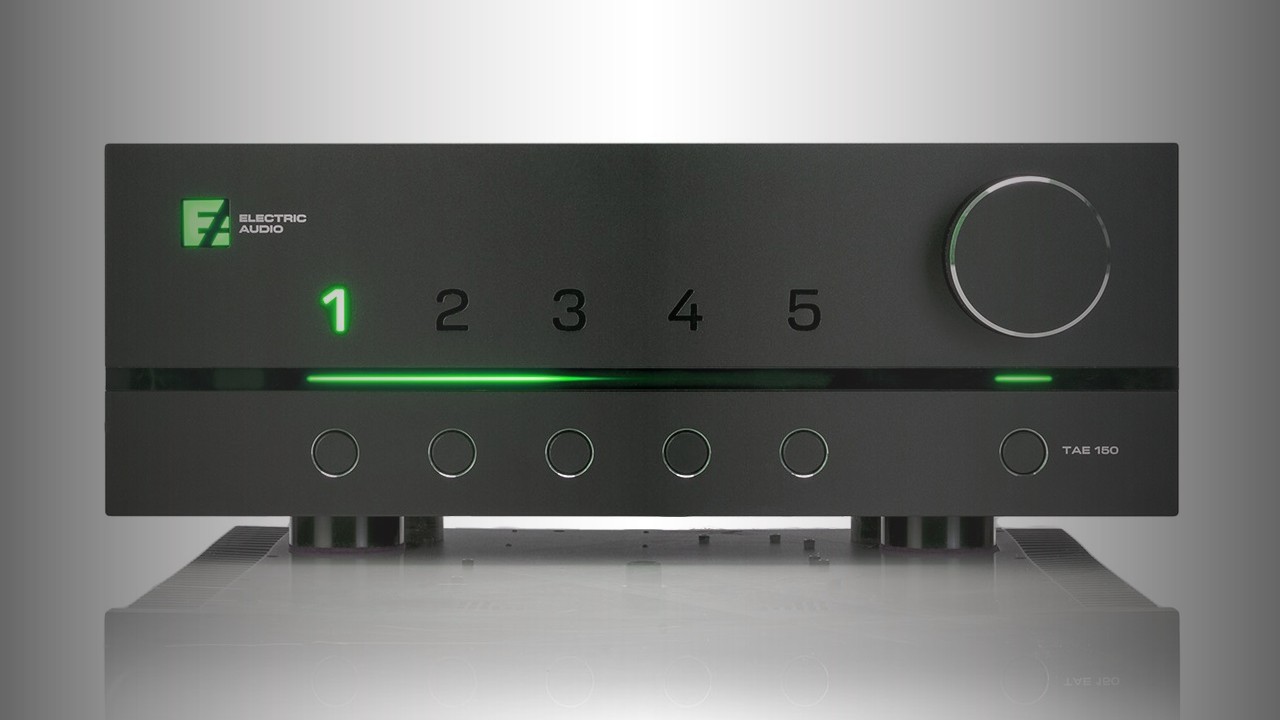
Electric Audio TAE 150 integrated amplifier and PAE 150 stereo power amplifier, the brand’s inaugural amplification models.
Electric Audio’s first amplifier range separates the choice into the TAE 150 integrated amplifier and the PAE 150 stereo power amplifier.
The TAE 150 uses a semiconductor design and is rated at approximately 130 watts per channel into eight ohms, 215 watts into four ohms, and 365 watts into two ohms.
Its power supply incorporates a 1,000 VA transformer and 80,000 microfarads of filter capacity, with the manufacturer claiming peak current of up to 70 amps. Connectivity is intentionally analog-only, making the TAE 150 more appropriate for systems that already have the required source components. The PAE 150 offers a dedicated power-amplifier route for users with a separate preamplifier.
Best for: Analog systems requiring substantial stated power
- Integrated and separate power-amplifier options
- TAE 150 rated for two-, four-, and eight-ohm loads
- Substantial transformer and filter capacity
- Analog-only signal path
Verdict: The TAE 150 and PAE 150 form a focused amplifier pairing for listeners who value analog simplicity and strong published power figures over integrated digital facilities.
3. BonaWatt Tamesis
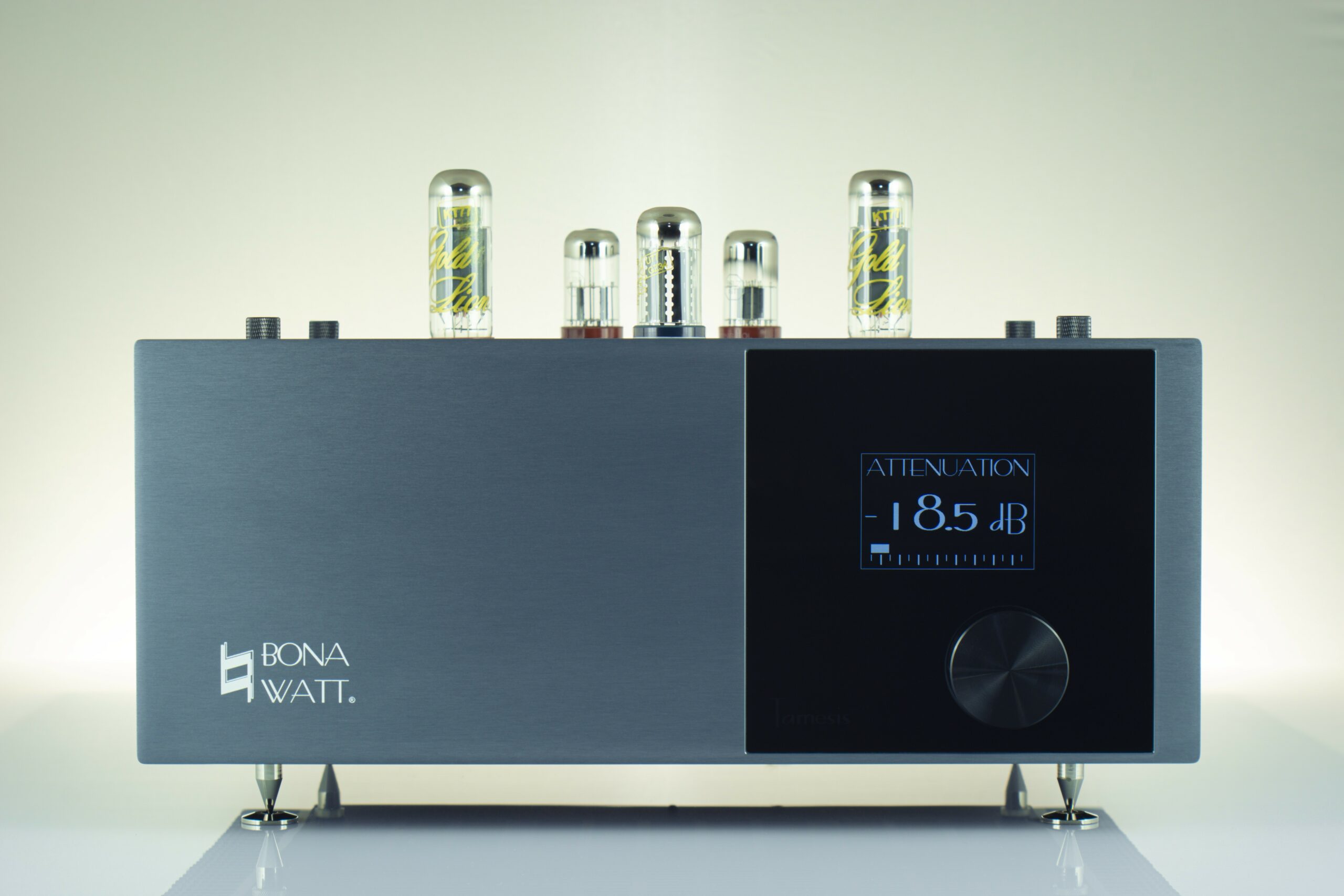
BonaWatt Tamesis single-ended Class A integrated amplifier, built around KT77 output tubes and 6SL7GT preamplifier tubes.
The BonaWatt Tamesis takes the purist route with a single-ended, ultra-linear Class A tube circuit.
It uses KT77 beam tetrodes alongside 6SL7GT preamplifier tubes and delivers 11.5 watts per channel into either four or eight ohms.
BonaWatt also specifies its Parabolic Power Bias technology and a frequency response of 6 Hz to 40 kHz at the minus-three-decibel points. That modest output makes speaker selection especially important: the Tamesis is intended for high-efficiency loudspeakers and more intimate listening environments rather than systems that depend on large reserves of amplifier power.
Best for: Efficient speakers and intimate tube-based systems
- Single-ended Class A tube topology
- Four- and eight-ohm output support
- Specified 6 Hz to 40 kHz frequency response
- Purposeful match for high-efficiency speakers
Verdict: The Tamesis is a specialized low-power integrated amplifier whose appeal depends on pairing its single-ended tube circuit with suitably efficient loudspeakers.

4. McIntosh MC462
McIntosh MC462 stereo power amplifier with illuminated analog wattmeters, Power Guard indicators, and a polished stainless-steel chassis.
The McIntosh MC462 is a dedicated stereo power amplifier rated at 450 watts per channel.
Its Quad Balanced topology uses two matched amplifier sections in each channel, with their outputs combined through McIntosh Autoformers.
The supplied specification lists total harmonic distortion at 0.005 percent. Power Guard protection indicators sit between the amplifier’s two front-panel wattmeters, which offer normal and peak-hold display modes. A polished stainless-steel chassis, glass front panel, fiber-optic and LED illumination, and aluminum handles give the MC462 the familiar construction and presentation associated with McIntosh power amplifiers.
Best for: High-power stereo systems using a separate preamplifier
- 450 watts per channel
- Quad Balanced circuit topology
- Autoformer-coupled outputs
- Power Guard protection and peak-hold wattmeters
Verdict: The MC462 combines very high stated output, McIntosh’s Autoformer-based architecture, and informative front-panel metering in a dedicated stereo power amplifier.

5. Musical Fidelity Nu-Vista 600.2
Musical Fidelity Nu-Vista 600.2, an analog dual-mono integrated amplifier incorporating a Class A NuVistor stage.
The Musical Fidelity Nu-Vista 600.2 is an entirely analog integrated amplifier built around a dual-mono architecture and a Class A stage using NuVistor tubes.
It is rated at 160 watts per channel into eight ohms and 300 watts into four ohms, with stated peaks of 500 watts into two ohms.
Compared with its predecessor, the design replaces an input-switching integrated circuit with relays and revises the output, preamplifier, and NuVistor stages. Its laser-trimmed volume control is specified for a gain error of plus or minus 0.5 dB even at low settings, an important detail for channel matching during quiet listening.
Best for: Powerful all-analog integrated systems
- Dual-mono analog architecture
- NuVistor-based Class A stage
- Relay input switching
- Laser-trimmed volume control
Verdict: The Nu-Vista 600.2 pairs substantial published output with a thoroughly revised analog design and unusually precise volume control.
6. Goldmund Telos 1800
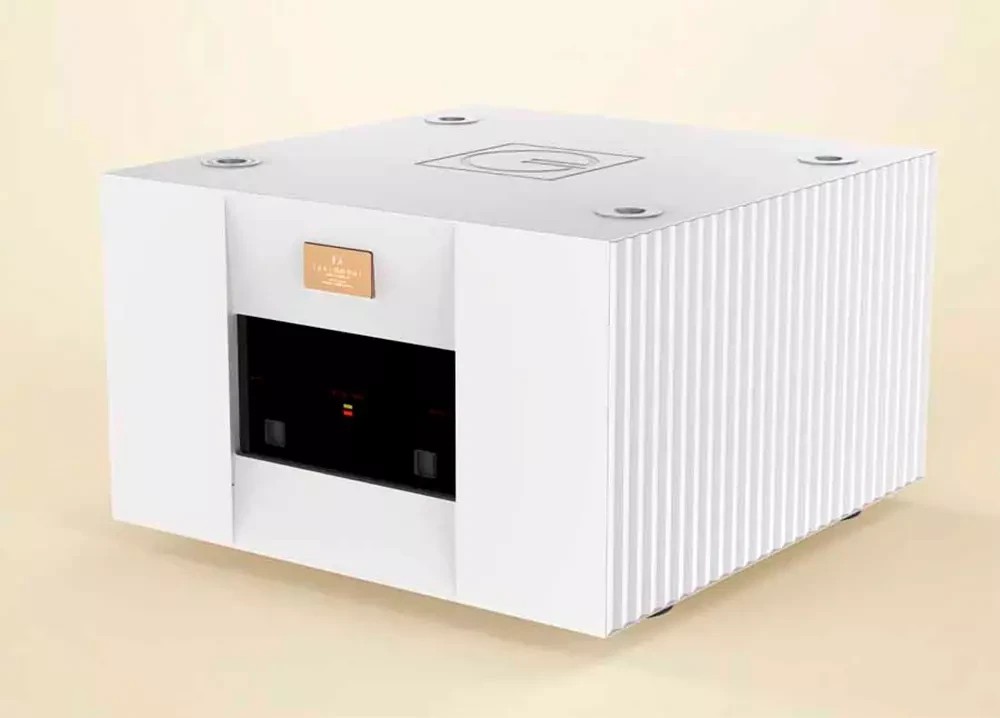
Goldmund Telos 1800 monoblock power amplifier, housed in a rigid enclosure constructed with 12 mm panels.
The Goldmund Telos 1800 is a monoblock power amplifier, so a stereo system requires one unit for each channel.
It is rated at 420 watts into eight ohms at one percent total harmonic distortion, while Goldmund also specifies distortion below 0.05 percent at a 30-volt output.
Further published figures include less than 3 microvolts of noise across the audio range, 35 dB of gain, a 110 dB dynamic range, and a damping factor of 600 at 1 kHz into eight ohms. The enclosure uses 12 mm panels intended to increase rigidity and improve vibration dissipation.
Best for: Reference-scale systems built around separate monoblocks
- 420-watt monoblock configuration
- Specified noise below 3 microvolts
- Published damping factor of 600
- Rigid 12 mm enclosure panels
Verdict: The Telos 1800 is a highly specialized monoblock defined by substantial stated power, low published noise, and heavily engineered casework.
7. Circle Labs AS100
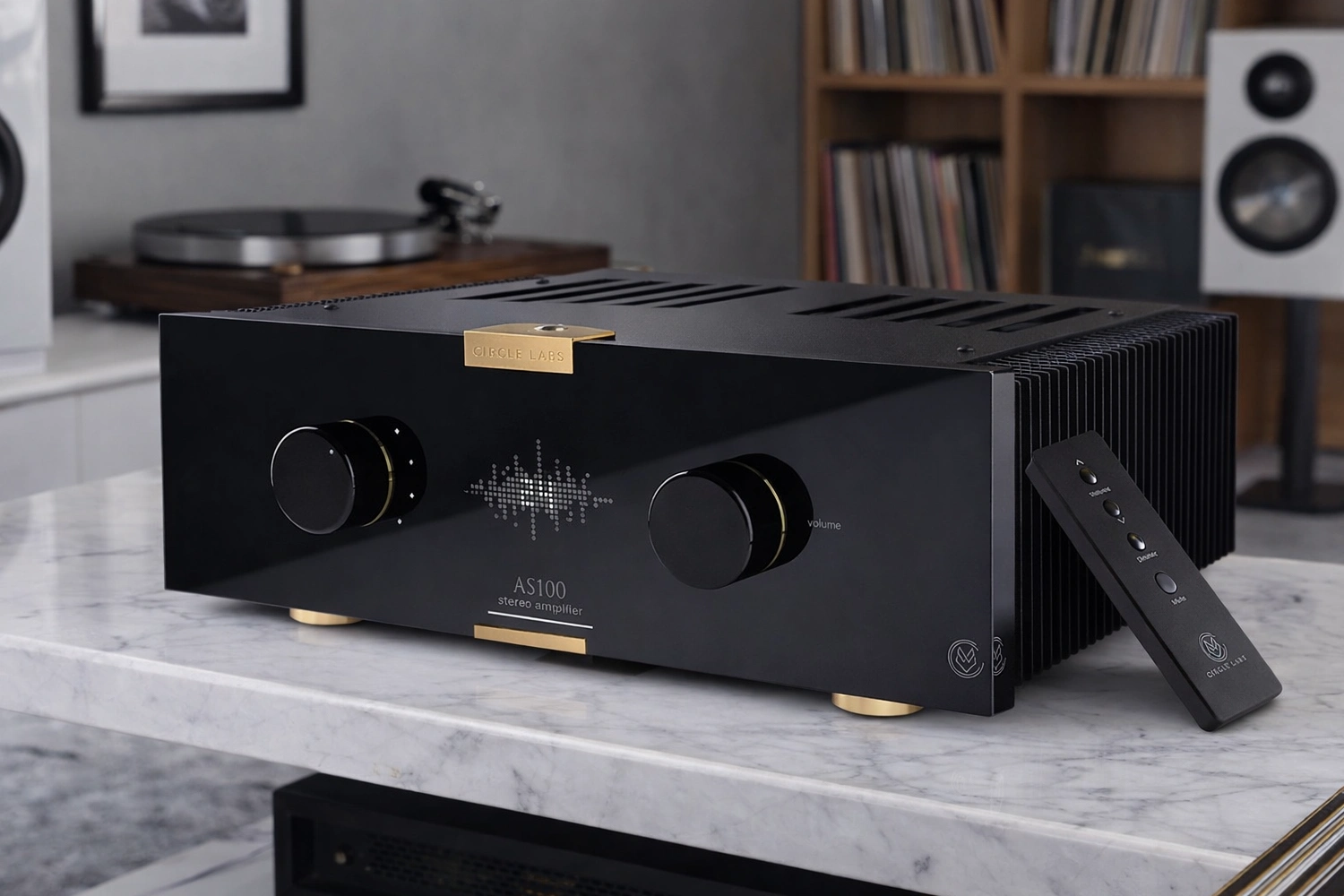
Circle Labs AS100 integrated amplifier, featuring dual-mono construction and a relay-controlled 63-step resistor-ladder volume system.
Circle Labs designed the AS100 as a minimalist transistor integrated amplifier, concentrating on signal handling and power-supply stability rather than an extensive feature list.
Its volume control is a 63-step resistor ladder using 0.1 percent tolerance resistors and relay switching.
The circuit is fully dual-mono, with a separate toroidal transformer for each channel, while low-noise Burr-Brown J-FET devices serve the input stage and bipolar transistors supply output current. A total filter capacity of 200,000 microfarads supports the power supply. Circle Labs specifies a frequency response of 3 Hz to 500 kHz at minus 3 dB and a damping factor above 250 into eight ohms.
Best for: Minimalist analog systems prioritizing circuit precision
- Fully dual-mono construction
- 63-step relay-controlled resistor-ladder volume control
- Separate toroidal transformer for each channel
- 200,000-microfarad filter capacity
Verdict: The AS100 is a deliberately focused integrated amplifier distinguished by dual-mono construction, precise stepped volume control, and a substantial power supply.
8. AVM Inspiration AS 2.3
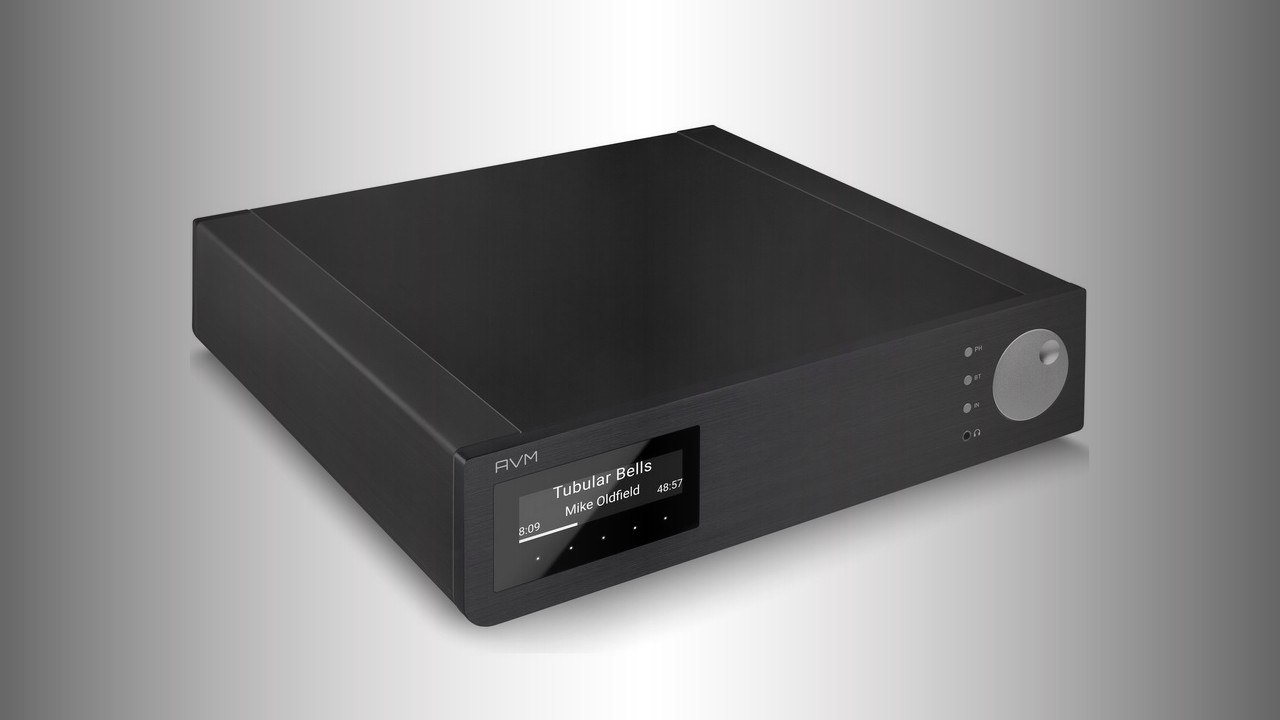
AVM Inspiration AS 2.3, a compact streaming integrated amplifier powered by the company’s X-Stream Engine platform.
The AVM Inspiration AS 2.3 is a compact streaming integrated amplifier built around AVM’s X-Stream Engine.
It can access network storage, music servers, internet radio, podcasts, and supported online services.
Qobuz, Tidal, and Highresaudio are integrated through the RC X application, with Spotify Connect, Apple AirPlay 2, and Roon Ready support adding alternative playback routes. Network access is available over Ethernet or WLAN, while Bluetooth accommodates direct smartphone connections. AVM describes the AS 2.3 as almost all-in-one because it omits the CD drive found in the related CS 2.3. Firmware updates are intended to provide a route for future service and format support.
Best for: Compact systems centered on network audio
- Broad network and streaming support
- Ethernet, WLAN, and Bluetooth connectivity
- Apple AirPlay 2 and Roon Ready support
- Compact integrated format
Verdict: The AS 2.3 is a persuasive hub for listeners who want extensive streaming and network playback without the CD mechanism of AVM’s closely related receiver.
9. Bryston Bi-200
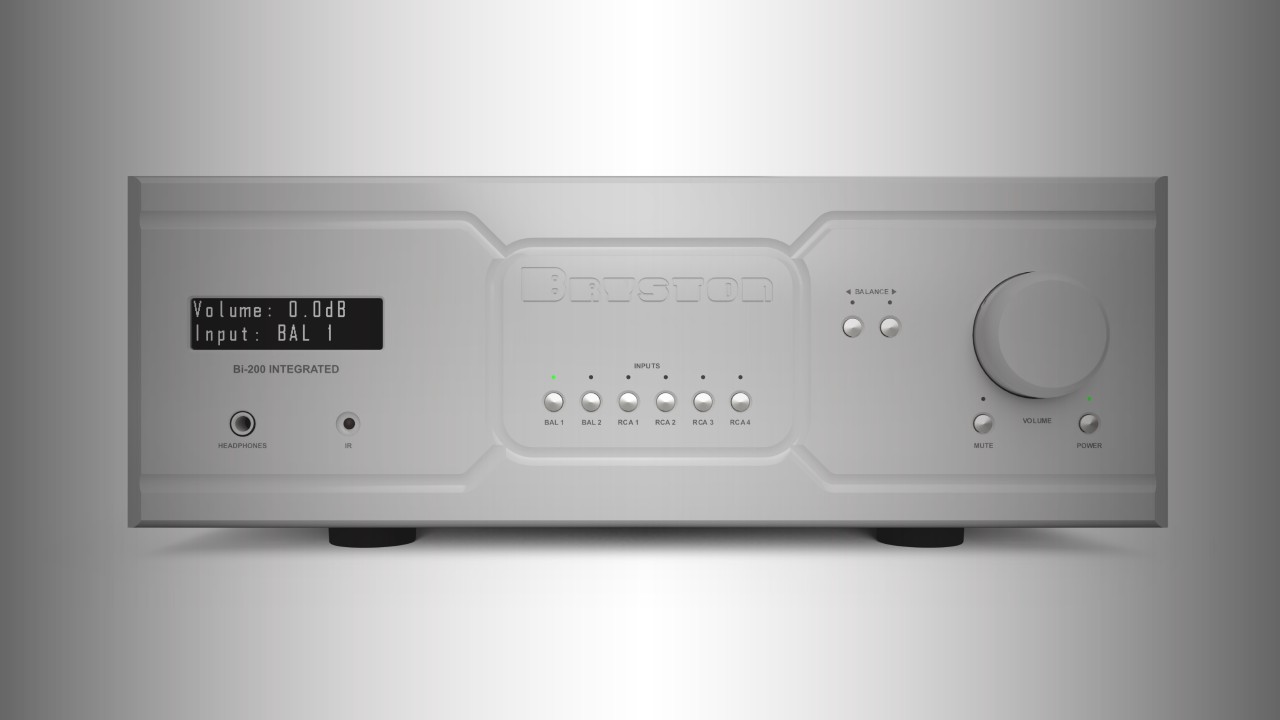
Bryston Bi-200 integrated amplifier, combining fully balanced construction with RCA and XLR connectivity.
The Bryston Bi-200 combines the company’s BP-19 preamplifier and 3B Cubed power-amplifier concepts in a single chassis.
It delivers a stated 200 watts per channel into eight ohms and employs fully balanced construction.
Four RCA and two XLR inputs support analog sources, while fixed and variable outputs in both connector formats can feed a separate power amplifier or subwoofer. Vinyl playback is optional rather than standard: Bryston offers an internal BP-3 moving-magnet phono stage. The amplifier is available in two chassis widths and in silver or black finishes.
Best for: Balanced analog systems needing flexible expansion
- 200 watts per channel into eight ohms
- Fully balanced construction
- RCA and XLR inputs and outputs
- Optional internal moving-magnet phono stage
Verdict: The Bi-200 brings Bryston preamplifier and power-amplifier designs into one chassis while retaining useful outputs for subwoofers or additional amplification.
10. Cayin HA-300 MK3
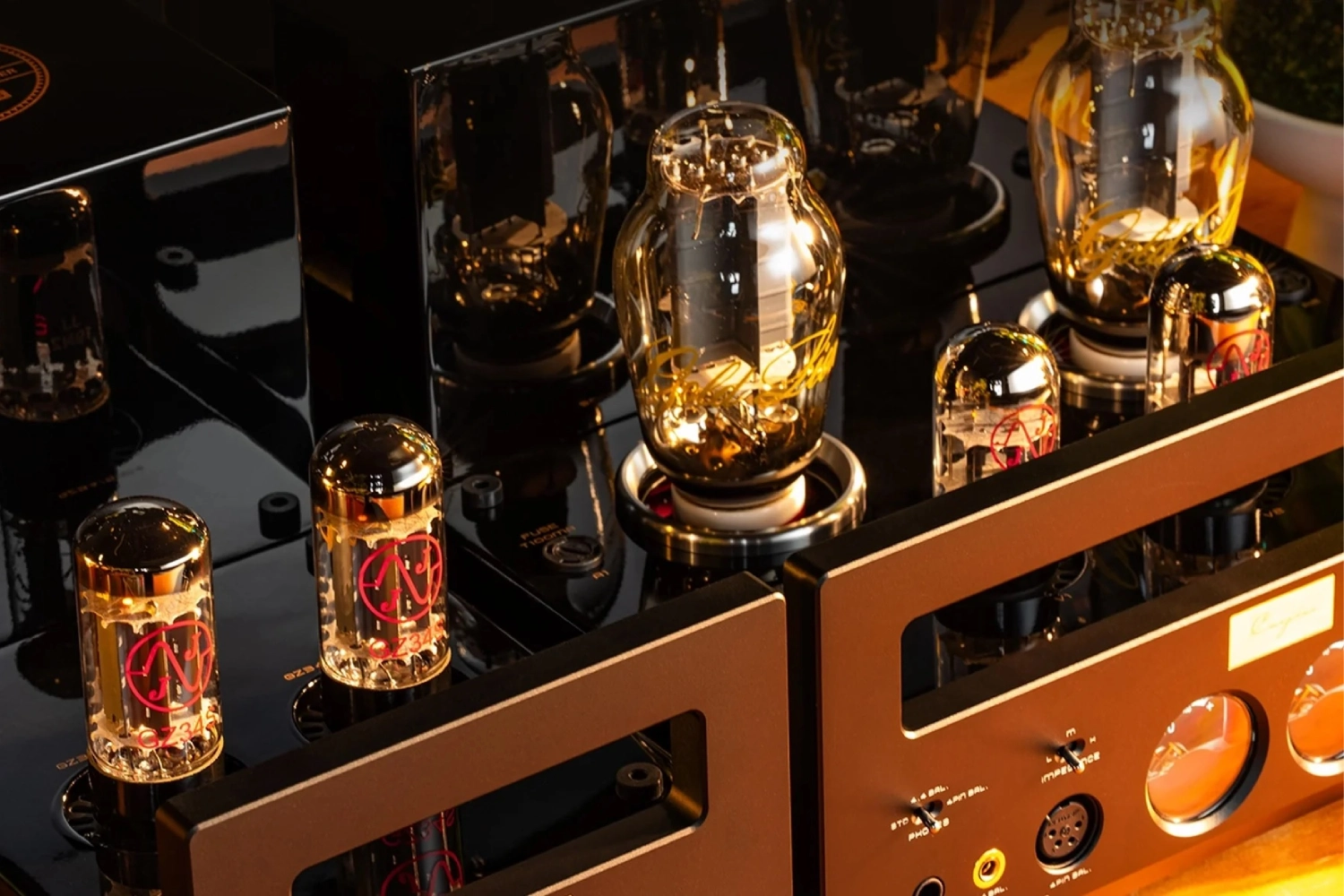
Cayin HA-300 MK3 headphone amplifier and its separate power-supply chassis, built around a single-ended Class A 300B circuit.
Unlike the speaker amplifiers elsewhere in this selection, the Cayin HA-300 MK3 is designed primarily for headphones and desktop hi-fi.
It retains a single-ended Class A topology with 300B output tubes and uses a separate external power supply, giving the system a two-chassis layout.
Cayin describes the third-generation circuit as offering greater output power, improved noise immunity, more connectivity, and compatibility with a wider range of headphones than its predecessor. Regulated, low-noise voltage amplification and a stepped independent power supply are central to the revised design.
Best for: High-end tube headphone and desktop systems
- Single-ended Class A tube circuit
- 300B output tubes
- Separate external power supply
- Designed for a wider range of headphones than its predecessor
Verdict: The HA-300 MK3 is the specialist choice for headphone listeners seeking a two-chassis, single-ended 300B amplifier rather than a conventional speaker amplifier.
Frequently asked questions
How much amplifier power do I need?
Start with your speaker sensitivity, nominal impedance, room size, listening distance, and preferred volume.
The 11.5-watt BonaWatt Tamesis is intended for high-efficiency speakers, while models such as the McIntosh MC462 and Goldmund Telos 1800 provide far greater stated output for systems with more demanding power requirements.
Should I choose an integrated amplifier or a separate power amplifier?
An integrated amplifier combines volume control, source selection, and power amplification in one chassis, reducing component count and cabling.
A power amplifier such as the McIntosh MC462, Goldmund Telos 1800, or Electric Audio PAE 150 requires a separate preamplifier but allows each part of the system to be selected or upgraded independently.
Do I need a streaming amplifier?
A streaming amplifier is useful when network services, internet radio, or local server playback are central to the system.
The Nubert nuConnect ampXL and AVM AS 2.3 integrate network playback, whereas analog-focused models require a separate streamer or digital source.
What connections should I check before buying an amplifier?
List every source and destination before deciding.
Confirm the required RCA or XLR inputs, phono compatibility, digital connections, subwoofer outputs, network access, and headphone support.
Also note that optional features matter: the Nubert requires an adapter for HDMI ARC, while the Bryston Bi-200 offers its moving-magnet phono stage as an option.
Choosing the Right Amplifier for Your System
Begin with function rather than headline power.
If the amplifier must serve as the system’s source hub, the Nubert nuConnect ampXL offers DAC, streaming, phono, DSP, and room-calibration facilities, while the AVM Inspiration AS 2.3 concentrates on broad network playback in a compact format.
For an all-analog integrated system, the Musical Fidelity Nu-Vista 600.2, Bryston Bi-200, Circle Labs AS100, and Electric Audio TAE 150 provide clearly differentiated combinations of power, topology, connectivity, and volume control. Speaker matching remains essential. Published wattage should be considered alongside impedance behavior and sensitivity, particularly with the 11.5-watt BonaWatt Tamesis. Dedicated power amplifiers such as the McIntosh MC462 and Goldmund Telos 1800 also require an appropriate preamplifier; the Goldmund is a monoblock and therefore needs two units for stereo reproduction. The Cayin HA-300 MK3 belongs to a different use case altogether, serving personal audio rather than a conventional loudspeaker system. Before buying, verify every physical and operational requirement: the number and type of inputs, phono-stage compatibility, balanced connectivity, subwoofer outputs, streaming-service support, room-correction needs, chassis space, ventilation, and whether optional accessories are necessary. Once those practical points are settled, arrange an audition with the intended speakers or headphones where possible. Amplifier specifications can narrow the field, but they cannot establish personal tonal preference or guarantee compatibility with every load and listening room.



Join the discussion
Share your thoughts, listening impressions or product experience.