
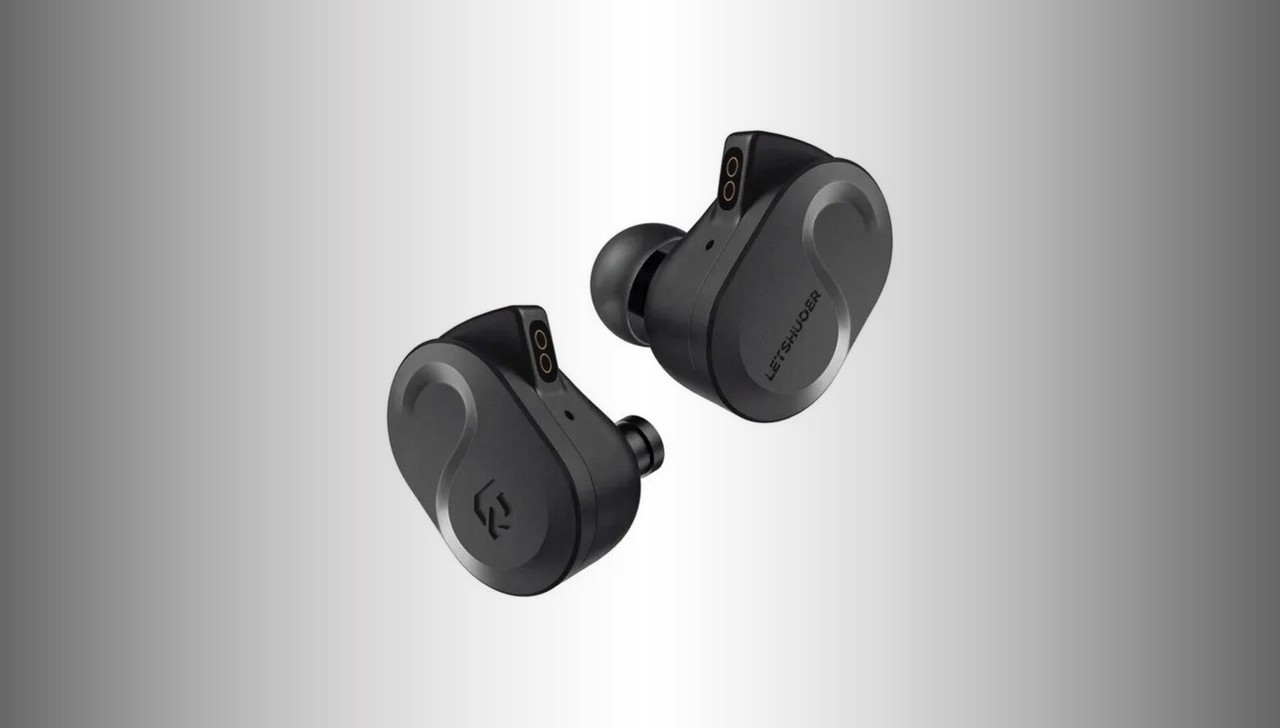
The Letshuoer S08 is positioned as an accessible wired in-ear monitor for listeners who are interested in planar driver technology without moving into a high-cost category. Its headline feature is a fourth-generation 13mm planar driver developed with Letshuoer’s active participation, supported by a nanoscopic magnetron sputtering process and a surround diaphragm structure intended to improve stability, treble resolution, and low-frequency performance. Around that driver, Letshuoer has built a compact metal-bodied earphone with detachable cabling, two common output options, and specifications that make it straightforward to understand as part of a modern portable or desktop listening setup. At $99, the S08’s appeal rests not on extravagance, but on the way it combines a focused driver concept with practical everyday design choices.
A 13mm planar driver as the centerpiece
The defining element of the Letshuoer S08 is its fourth-generation 13mm planar driver. Planar magnetic designs are attractive to many headphone and IEM enthusiasts because they use a diaphragm and conductive trace arrangement that differs from conventional dynamic-driver construction. In the S08, the emphasis is on a newly developed planar unit that is intended to deliver improved sound quality and greater stability compared with previous generations.
For a prospective owner, the significance is not simply that the S08 uses a planar driver, but that the entire product appears to be organized around making that driver work effectively in an in-ear format. A 13mm driver is relatively substantial for an IEM, and the published design focus suggests that Letshuoer has paid attention to the diaphragm, voice coil deposition, and surrounding support structure rather than treating the driver as a generic component. That gives the S08 a clear technical identity in a market where many wired earphones can look similar on paper.
Nanoscopic magnetron sputtering and why it matters
One of the S08’s most distinctive documented technologies is Letshuoer’s use of a nanoscopic magnetron sputtering process on the diaphragm. This process deposits a voice coil layer onto the diaphragm, with the coating described as penetrating deeply into the substrate. The practical goal is greater stability and durability, both important in a miniature transducer that must move quickly and consistently while operating inside a compact enclosure.
The process is also connected to high-frequency performance. Letshuoer describes the treatment as improving high-frequency resolution and helping produce a more refined and dynamic presentation. Without making listening claims, it is fair to say that the engineering intent is clear: the S08 is designed to reduce the compromises that can occur when a thin diaphragm, conductive layer, and magnetic system must operate together at very small scale. For buyers who value driver engineering, this manufacturing detail is one of the product’s more interesting points.
A surround diaphragm approach to planar bass challenges
Planar drivers are often discussed for speed, control, and detail, but the source material acknowledges a traditional challenge: low-frequency performance can be difficult to optimize, particularly when the design must fit into an in-ear housing. Letshuoer’s solution for the S08 is a PTR elastic film frame around the edge of the diaphragm. This surround diaphragm arrangement is intended to improve stretchability and stability.
That design choice matters because bass performance in an IEM depends not only on driver size or frequency range claims, but also on how well the diaphragm is controlled and supported. Letshuoer states that this optimization increases bass depth and density, while also contributing to soundstage width and depth. These are design goals rather than independent test results, but they help explain how the S08 is intended to address a known limitation of some planar implementations. The product is not merely described as planar for novelty; its structure is presented as a response to specific planar-driver behavior.
Metal construction with a clear visual identity
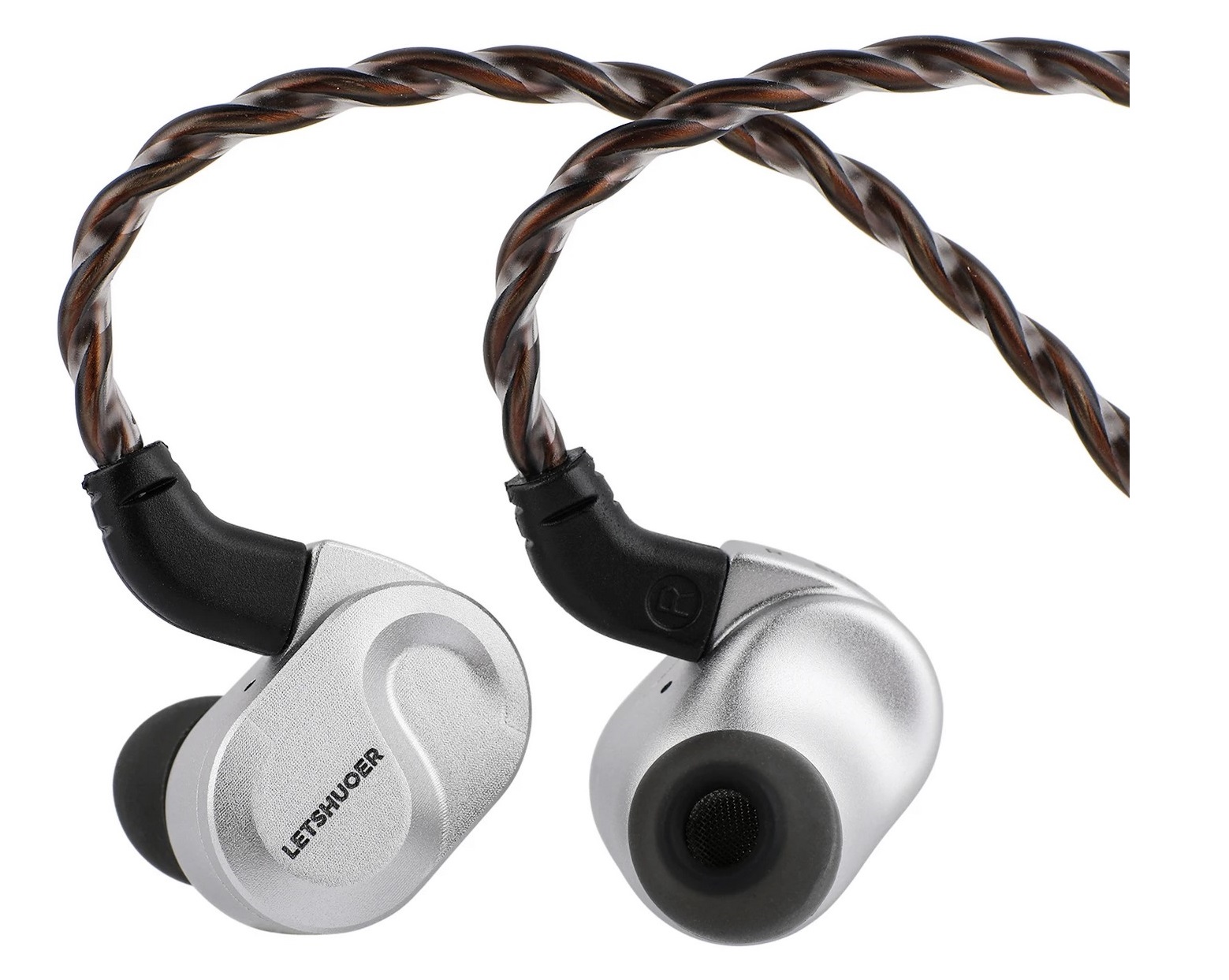
The S08 uses a precision CNC-machined metal body, available in black and silver. Its shape is inspired by the number 8, giving it a visual theme that is more deliberate than a plain generic shell. A streamlined, bright appearance may not determine audio performance, but it can influence ownership satisfaction, especially for an in-ear monitor that is handled frequently, worn visibly, and stored in a portable kit.
Metal housings also communicate a particular design priority. They can provide a more solid physical feel than basic plastic shells, and CNC machining allows tighter control over the enclosure shape. The published information does not provide weight or fit details, so comfort cannot be assumed, but the material and manufacturing method point to a product that is meant to feel robust and carefully finished. For a $99 wired IEM, that combination of driver emphasis and metal construction is a notable part of its proposition.
A cable system built for flexibility
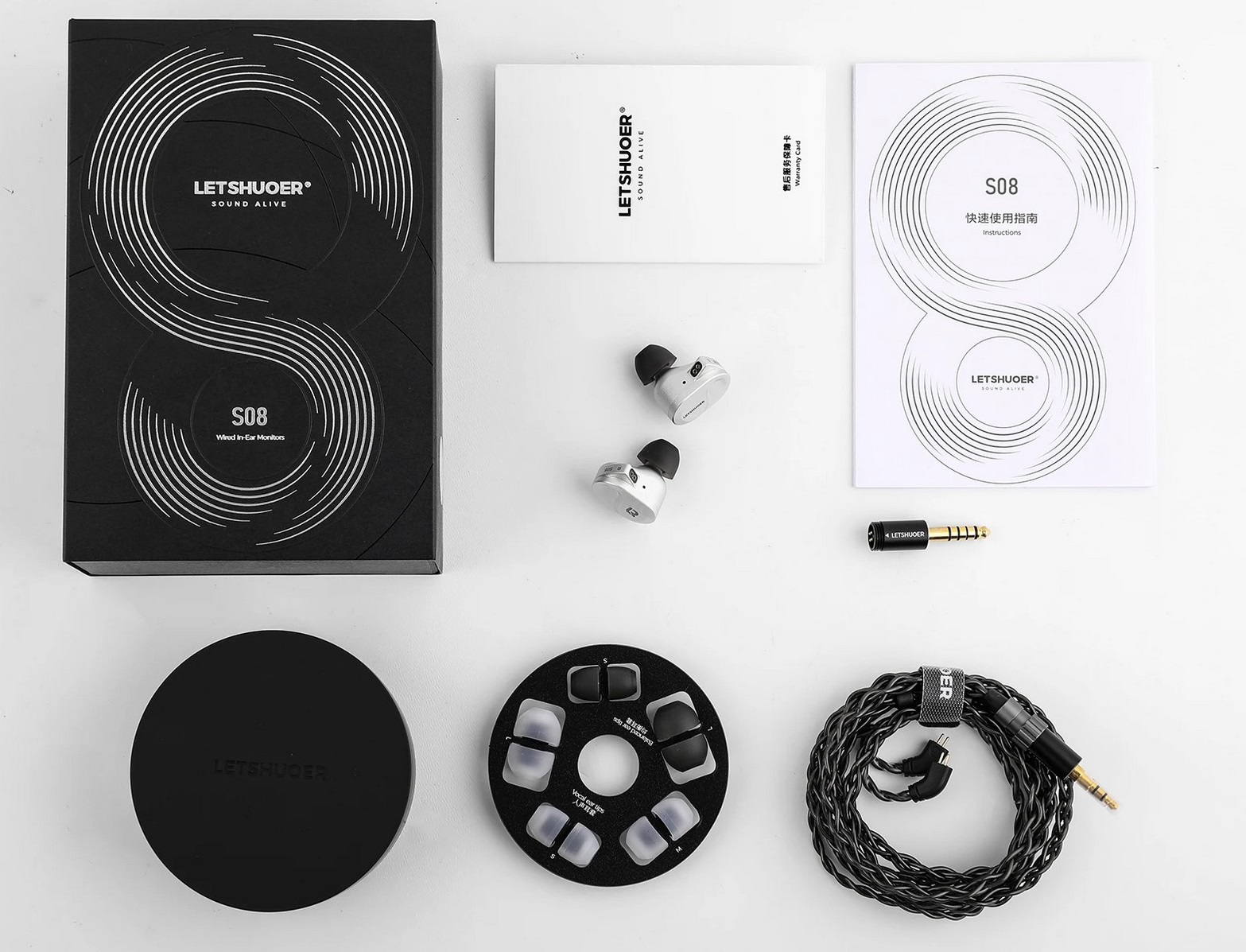
Letshuoer supplies the S08 with a cable made from four cores of 30-strand 0.05mm silver-plated copper wire. The stated purpose is efficient signal transmission, with the cable contributing to the earphone’s overall design as a serious wired monitor rather than an afterthought. Cable materials and construction are sometimes debated, but a well-specified detachable cable is still useful in a practical sense: it affects handling, termination options, and long-term serviceability.
The S08 uses a 0.78mm two-pin connector, a widely recognized style in the IEM world. This gives the earphone a modular character, because the cable is not permanently fixed to the shell. The inclusion of interchangeable 3.5mm and 4.4mm plugs adds further flexibility. A 3.5mm connection remains common for many portable devices, dongles, compact DAC/amps, and headphone outputs, while 4.4mm balanced outputs are frequently found on dedicated digital audio players and desktop or portable headphone amplifiers. For owners with more than one source, being able to switch plugs can reduce the need to buy a separate cable immediately.
Specifications that support broad wired use
The S08 is specified with 105dB sensitivity, 26-ohm resistance, and a frequency range of 20Hz to 40000Hz. These figures do not tell the full story of how an earphone will sound, and they should not be treated as a substitute for personal matching. However, they do provide a basic technical frame. The 26-ohm resistance places the S08 in a range that is familiar for portable wired IEMs, while the 105dB sensitivity suggests that it is designed with practical everyday driving in mind.
The frequency range specification extends from the conventional lower boundary of human hearing to 40000Hz. Such a figure should be understood as a manufacturer specification rather than a promise of audible extension for every listener or system. Still, within the context of the S08’s planar driver and diaphragm treatment, it reinforces the product’s emphasis on bandwidth, high-frequency behavior, and driver capability.
Who the Letshuoer S08 is most suitable for
The S08 is most suitable for listeners who want a wired in-ear monitor with a distinct technical foundation. It should appeal to enthusiasts curious about planar driver designs, users who value detachable cables, and owners who have both 3.5mm and 4.4mm sources. Its documented feature set also makes sense for musicians and studio professionals who prefer a compact wired monitor with a metal shell and replaceable cable connection, provided the fit and voicing suit their personal requirements.
It may be less suitable for buyers whose priorities are wireless convenience, active electronic features, or a product selected primarily on the basis of a full set of published ergonomic details. The available documentation focuses on the driver, diaphragm manufacturing, cable, shell material, and core specifications; it does not establish claims about noise cancellation, app control, tuning presets, or measured performance. As a result, the S08 is best understood as a focused wired IEM for users who appreciate traditional audio hardware and driver-led design.
Conclusion
The Letshuoer S08 stands out through a clearly documented combination of technologies: a fourth-generation 13mm planar driver, nanoscopic magnetron sputtering for the diaphragm, a PTR elastic film surround intended to support bass stability, a CNC-machined metal body, and a detachable cable with interchangeable 3.5mm and 4.4mm plugs. Its strongest qualities are its focused planar-driver engineering, practical wired connectivity, and robust material choices at a $99 price point. It is an especially logical option for listeners, musicians, and studio-oriented users who want a compact wired IEM with a distinctive driver platform and flexible source matching, while remaining best judged by those who value documented design features over unsupported performance claims.

Join the discussion
Share your thoughts, listening impressions or product experience.